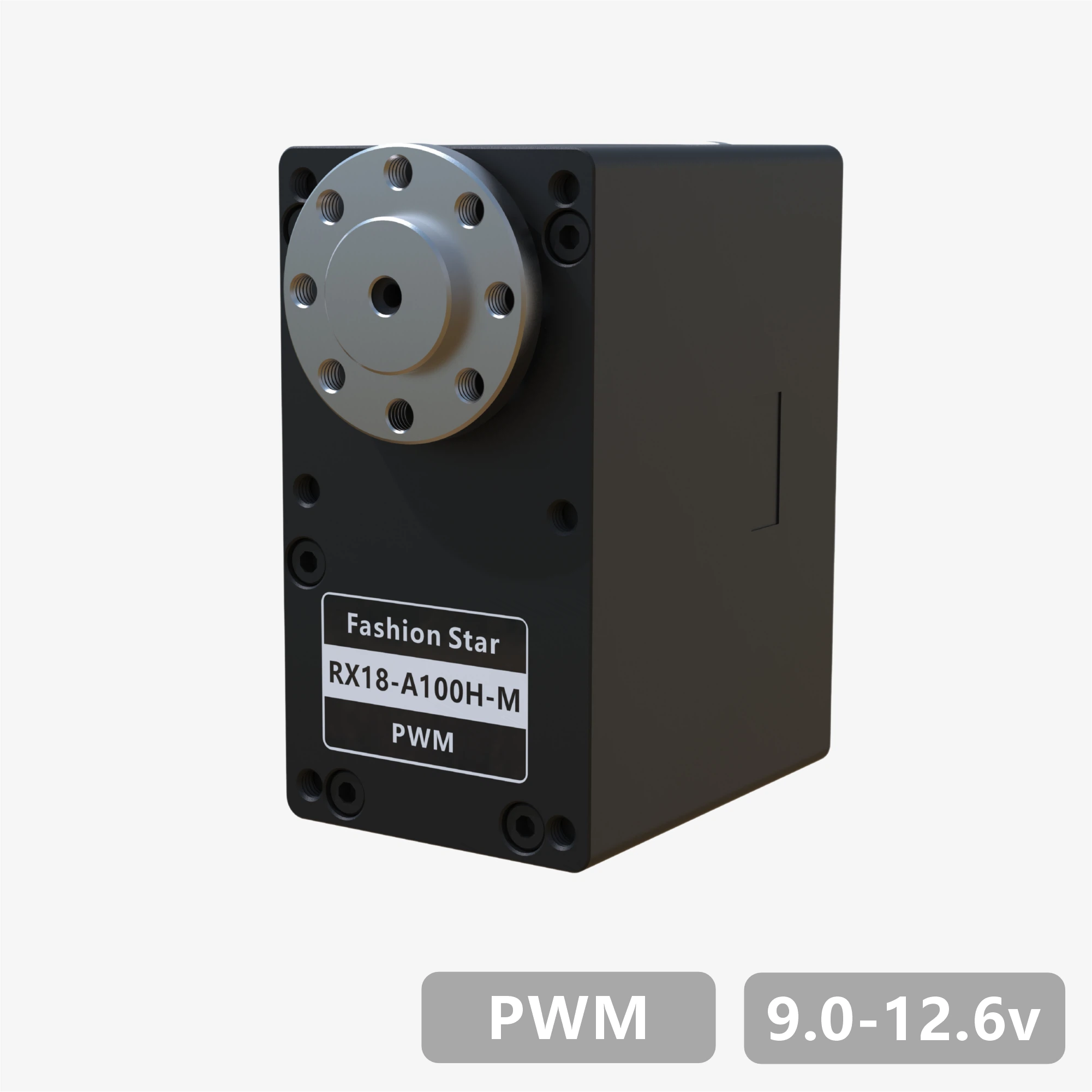
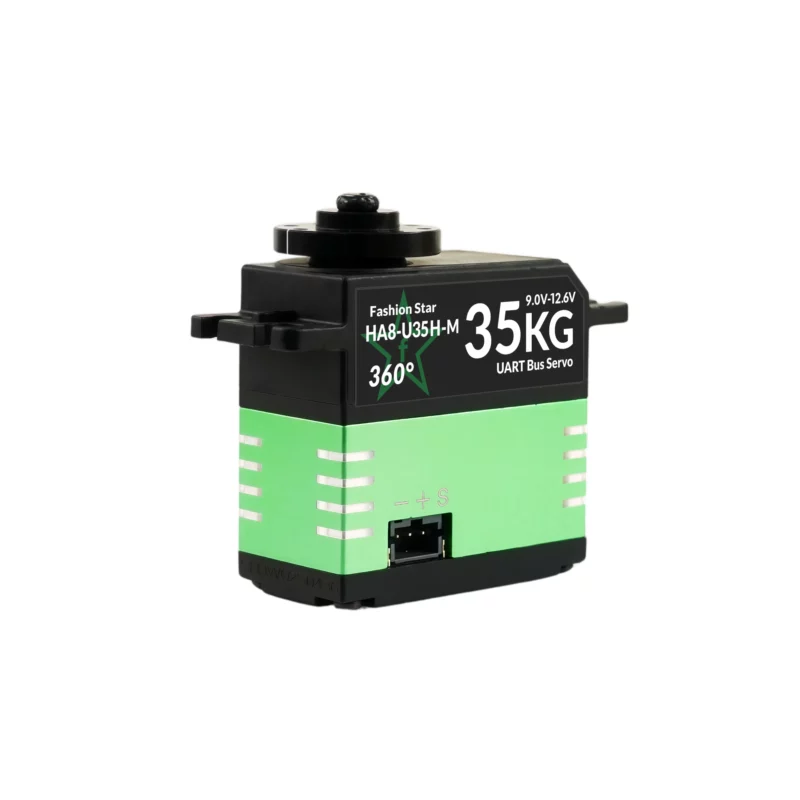
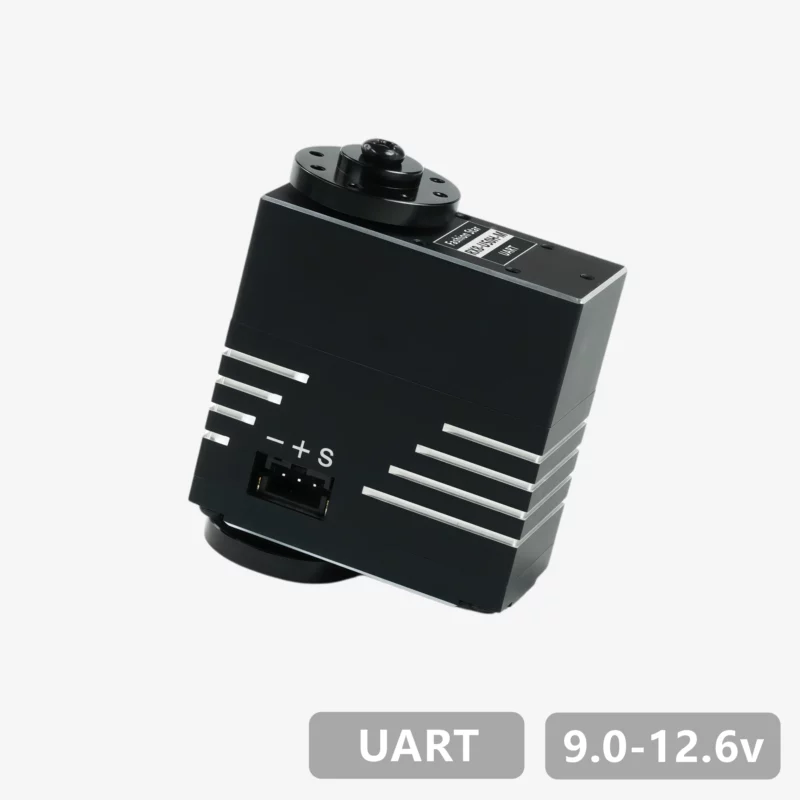
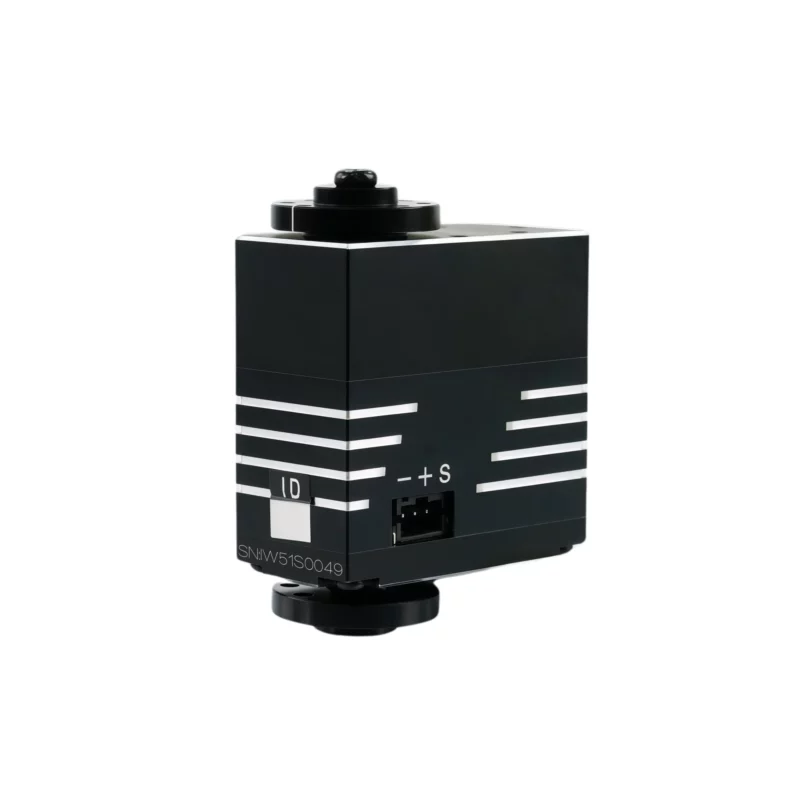
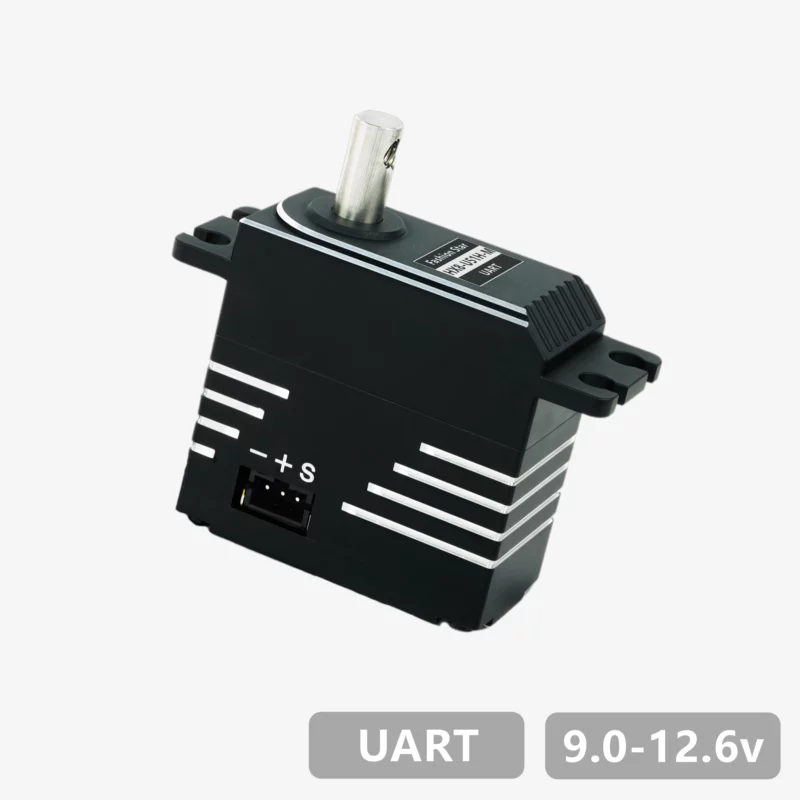
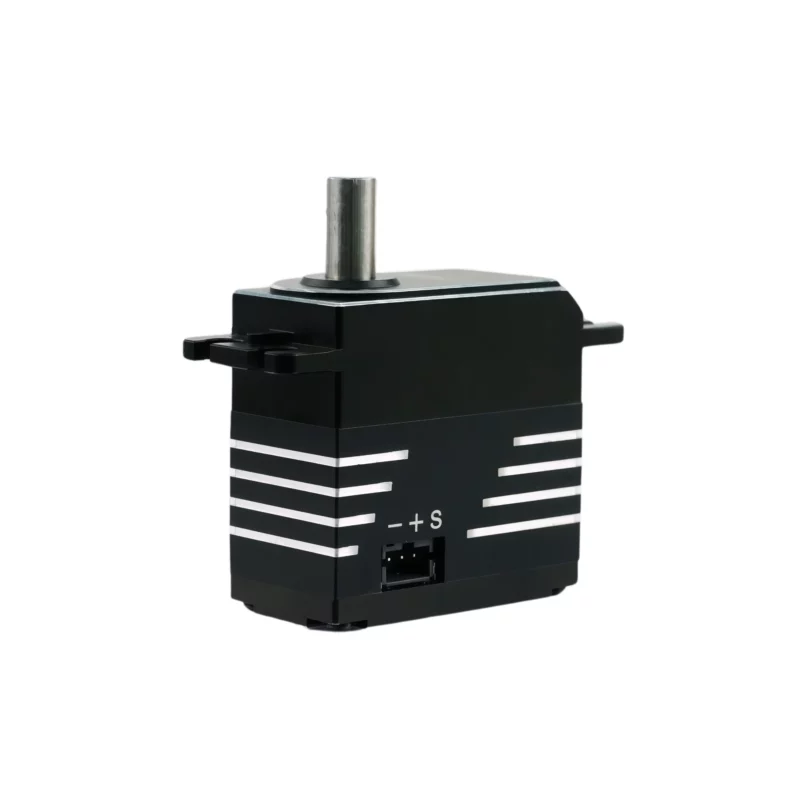
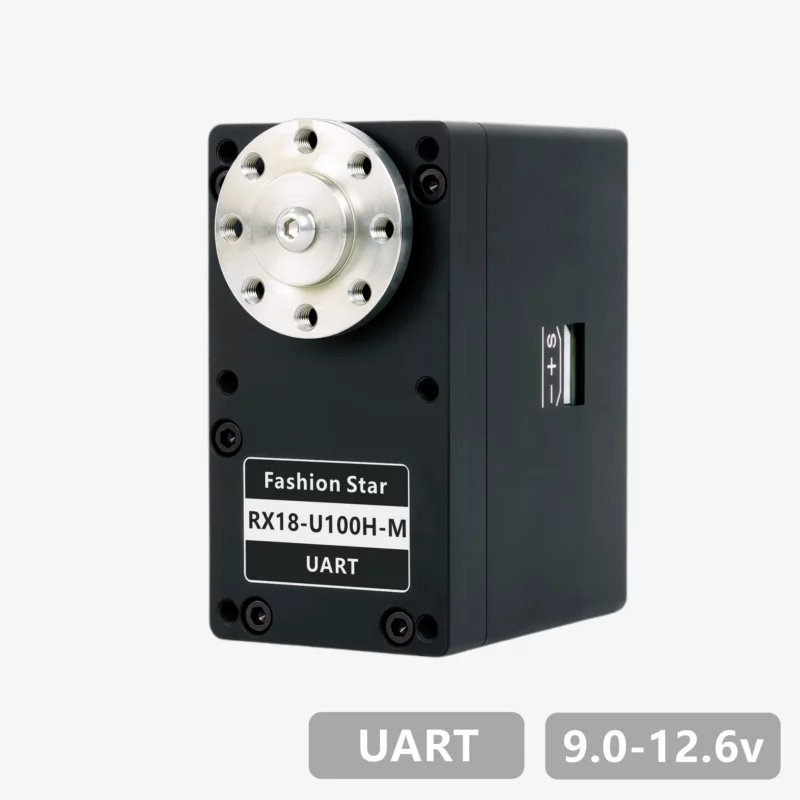
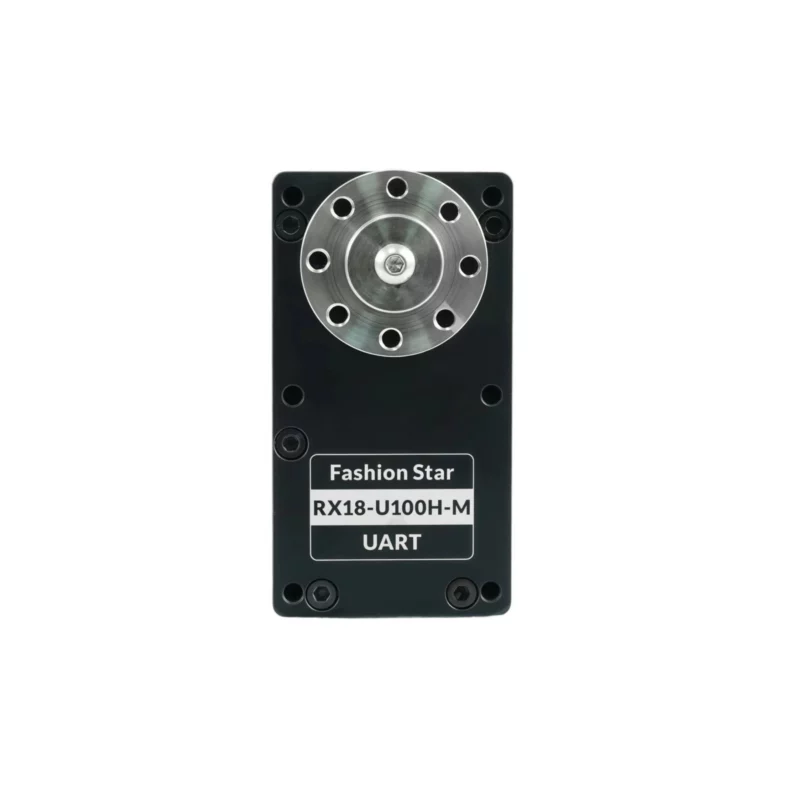
| Protocol Type | PWM |
|---|---|
| Input Voltage | 9.0 ~ 12.6V |
| Motor Type | Brushless |
| Position Sensor | 12-bit Contactless Absolute Encoder (Magnetic) |
| Effective Angle | 180° (@500→2500us) (Customizable) |
| Rotation Direction | Counterclockwise (500→2500us) (Customizable) |
| PWM Period Range | 3 ~ 40 ms |
| Dead Band | 2 μs |
| Gear Ratio | 392:1 |
| Output Spline Specification | Stainless Steel / 15T |
| Output Spline Support | Dual Ball Bearings |
| Interface | 5264-3Pin |
| Case Material | All Aluminum Alloy |
| Dimensions | 63 x 34 x 47 mm |
| Appearance | Dual-shaft |
| Weight | 230 g |
| Max Stall Torque | 9.80 N·m (100 kg·cm) |
| Max Continuous Torque | 4.90 N·m (50 kg·cm) |
| No Load Speed | 42 rpm (0.238 sec @ 60°) |
| Stall Current | 13 A |
| No Load Current | 700 mA |
| Standby Current | 60 mA |
Frequently Asked Questions About RP8-A46 PWM Servo
These FAQs explain how the RP8-A46 fits robotics, automation, education, and engineering projects, with details on protocol, power, torque, speed, documentation, and integration resources.
What makes the RP8-A46 a good PWM digital servo for robotics?
The RP8-A46 combines PWM control, coreless motor, potentiometer, and a 4.41 N·m (45 kg·cm) maximum stall torque in a servo package built for strong robotic joints, grippers, gimbals, and education or research platforms needing higher holding force where simple PWM control from an RC receiver or standard servo controller is required. This gives engineers a clearer match between communication method, torque class, and mechanical load than choosing a generic hobby servo.
When is the RP8-A46 PWM digital servo the right choice?
The RP8-A46 is appropriate when you need straightforward PWM control from a receiver, microcontroller, or standard servo controller. Compared with bus servos, this PWM robotic servo is simpler to integrate for direct position-control projects that do not require ID-based serial networking.
What power supply should be used with the RP8-A46?
Use a stable external power supply within the 6.0 ~ 8.4 V operating range. Because the RP8-A46 can reach 4.41 N·m (45 kg·cm) stall torque, the power system should provide enough current for startup, acceleration, and loaded motion; avoid powering the servo directly from a microcontroller board.
How does the RP8-A46 balance torque, speed, and size?
This model is specified with 4.41 N·m (45 kg·cm) stall torque. Its no-load speed is @8.4 V: 0.085 sec / 60° @7.4 V: 0.098 sec / 60° @6.0 V: 0.118 sec / 60°, and the weight is 65 g. These figures make it better suited for load-bearing joints rather than one-size-fits-all servo selection.
Can the RP8-A46 be used in multi-servo mechanisms?
Yes. The RP8-A46 can be used in multi-servo mechanisms when each PWM channel is driven by a suitable controller. Plan the wiring and power distribution carefully, especially when several high-torque digital servos move at the same time.
Where can I find documentation, drawings, and setup resources for the RP8-A46?
Use the product page sections for Documents, CAD Drawings, and related resources. Fashion Star Wiki resources also cover servo selection, communication protocols, wiring and power-supply guidance, debugging tools, SDK packages, and model or drawing downloads for the servo series.
What should I check before installing the RP8-A46 in a robot?
Check the 6.0 ~ 8.4 V power range, controller PWM compatibility, horn or bracket fit, mechanical load, and cable routing. The coreless motor and potentiometer configuration should be matched with the expected duty cycle and positioning accuracy of your robotic servo application.
Engineering note: Always confirm power input, wiring, mechanical load, and software limits before testing the RP8-A46 in a finished robot or automation system.
(function(){function init(){var root=document.querySelector('body.single-product #tab-wd_custom_tab_2 .fs-faq-acc');if(!root||root.dataset.singleOpen==='1')return;root.dataset.singleOpen='1';var items=root.querySelectorAll('details.fs-faq-item');items.forEach(function(item){item.addEventListener('toggle',function(){if(!item.open)return;items.forEach(function(other){if(other!==item)other.removeAttribute('open');});});});}if(document.readyState==='loading'){document.addEventListener('DOMContentLoaded',init);}else{init();}})();
{"@context":"https://schema.org","@type":"FAQPage","mainEntity":[{"@type":"Question","name":"What makes the RP8-A46 a good PWM digital servo for robotics?","acceptedAnswer":{"@type":"Answer","text":"The RP8-A46 combines PWM control, coreless motor, potentiometer, and a 4.41 N·m (45 kg·cm) maximum stall torque in a servo package built for strong robotic joints, grippers, gimbals, and education or research platforms needing higher holding force where simple PWM control from an RC receiver or standard servo controller is required. This gives engineers a clearer match between communication method, torque class, and mechanical load than choosing a generic hobby servo."}},{"@type":"Question","name":"When is the RP8-A46 PWM digital servo the right choice?","acceptedAnswer":{"@type":"Answer","text":"The RP8-A46 is appropriate when you need straightforward PWM control from a receiver, microcontroller, or standard servo controller. Compared with bus servos, this PWM robotic servo is simpler to integrate for direct position-control projects that do not require ID-based serial networking."}},{"@type":"Question","name":"What power supply should be used with the RP8-A46?","acceptedAnswer":{"@type":"Answer","text":"Use a stable external power supply within the 6.0 ~ 8.4 V operating range. Because the RP8-A46 can reach 4.41 N·m (45 kg·cm) stall torque, the power system should provide enough current for startup, acceleration, and loaded motion; avoid powering the servo directly from a microcontroller board."}},{"@type":"Question","name":"How does the RP8-A46 balance torque, speed, and size?","acceptedAnswer":{"@type":"Answer","text":"This model is specified with 4.41 N·m (45 kg·cm) stall torque. Its no-load speed is @8.4 V: 0.085 sec / 60° @7.4 V: 0.098 sec / 60° @6.0 V: 0.118 sec / 60°, and the weight is 65 g. These figures make it better suited for load-bearing joints rather than one-size-fits-all servo selection."}},{"@type":"Question","name":"Can the RP8-A46 be used in multi-servo mechanisms?","acceptedAnswer":{"@type":"Answer","text":"Yes. The RP8-A46 can be used in multi-servo mechanisms when each PWM channel is driven by a suitable controller. Plan the wiring and power distribution carefully, especially when several high-torque digital servos move at the same time."}},{"@type":"Question","name":"Where can I find documentation, drawings, and setup resources for the RP8-A46?","acceptedAnswer":{"@type":"Answer","text":"Use the product page sections for Documents, CAD Drawings, and related resources. Fashion Star Wiki resources also cover servo selection, communication protocols, wiring and power-supply guidance, debugging tools, SDK packages, and model or drawing downloads for the servo series."}},{"@type":"Question","name":"What should I check before installing the RP8-A46 in a robot?","acceptedAnswer":{"@type":"Answer","text":"Check the 6.0 ~ 8.4 V power range, controller PWM compatibility, horn or bracket fit, mechanical load, and cable routing. The coreless motor and potentiometer configuration should be matched with the expected duty cycle and positioning accuracy of your robotic servo application."}}]}
Shipping & Delivery
We ship orders to customers worldwide. Most orders are dispatched via DHL Express to provide fast, reliable international delivery with end-to-end tracking.
Processing Time
In-stock items are usually processed within 1–3 business days after payment is confirmed.
Shipping Method
Our default international shipping method is DHL Express. Other trusted express or air services may be used when appropriate.
Estimated Delivery Time
DHL Express delivery typically takes 3–7 business days after dispatch for most international destinations.
Shipping Cost
Shipping costs are calculated based on the destination, package weight, dimensions, and selected shipping method. The final shipping cost will be shown at checkout before payment.
For large-volume or special shipments, please contact us for a shipping quotation.
Customs Duties & Import Taxes
International orders may be subject to customs duties, import taxes, VAT/GST, brokerage fees, or other charges required by the destination country/region.
These charges are not included in the product price or shipping cost unless specifically stated. Customers are responsible for any applicable import duties, taxes, and customs-related fees. Please check with your local customs office before placing an order.
Order Tracking
Once your order has been shipped, we will provide a tracking number by email or through your account order details. Tracking information may take up to 24 hours to update after the shipment is collected by the carrier.
Delays & Special Situations
Delivery may be delayed due to public holidays, customs inspections, weather conditions, carrier disruptions, force majeure events, or other circumstances beyond our control.
