Difference Between Brushed Servo and Brushless Servo
1. Servo Naming Rules
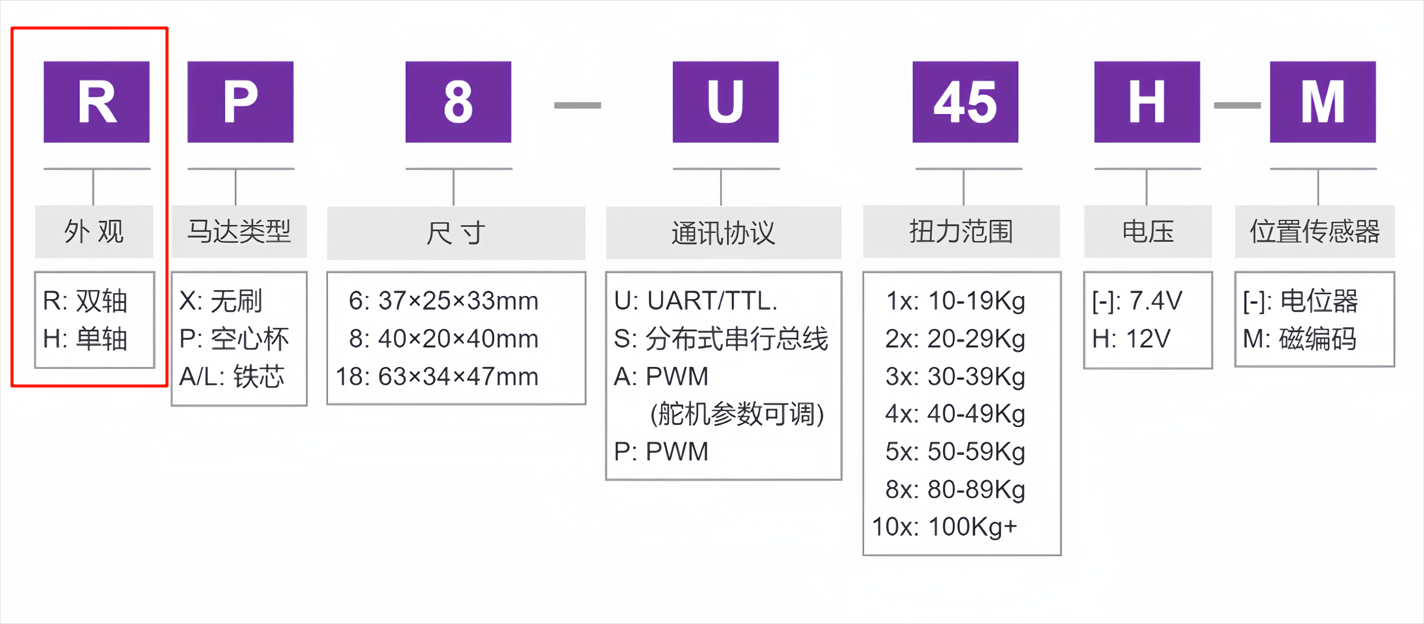
2. Accuracy and No-Load Service Life Comparison Between Brushed Servo and Brushless Servo
| Brushed Servo | Brushed Servo | Brushless Servo | |
|---|---|---|---|
| Internal Motor | Iron-core motor | Coreless motor | Brushless motor |
| No-load Accuracy | 0.5°-1° | 0.5°-1° | 0.2°-0.3° |
| No-load Service Life | 100 h | 400 h | 2000 h |
Users can select different servo models based on their specific requirements.
The differences in accuracy and no-load service life mainly come from the different internal motor types and gear materials used.
3. Differences Between Motor Types
3.1.1 Iron-Core Motor
- Rotor structure: The rotor is made from laminated silicon-steel iron cores, with copper windings wound around the core.
- Commutation method: Mechanical carbon brushes contact the commutator on the rotor shaft to switch the current direction and keep the rotor winding rotating continuously.
- Advantages: Simple structure and low manufacturing cost.
- Disadvantages: Lower efficiency, limited service life due to carbon brushes, higher noise, poorer heat dissipation, and lower accuracy.
3.1.2 Coreless Motor
- Rotor structure: The rotor has no iron core. The rotor winding is formed into a thin-walled cup-shaped structure.
- Commutation method: Mechanical carbon brushes contact the commutator on the rotor shaft to switch the current direction and keep the rotor winding rotating continuously.
- Advantages: Simple structure, better heat dissipation, and high power density.
- Disadvantages: Limited service life due to carbon brushes and lower accuracy.
3.1.3 Brushless Motor
- Stator/rotor structure: The stator usually has an iron core and windings, typically three-phase windings. The rotor is a permanent magnet, usually made with high-performance NdFeB magnets.
- Commutation method: Mechanical carbon brushes and commutators are completely removed. A motor controller algorithm detects rotor position, usually using Hall sensors or sensorless algorithms, and precisely controls the timing, current magnitude, and current direction applied to each stator phase. This creates a rotating magnetic field that pulls the permanent-magnet rotor.
- Advantages: High efficiency, long service life, no mechanical commutation wear parts, low noise, good heat dissipation because heat is mainly generated in the stator winding, and high starting torque.
- Disadvantages: More complex control and higher cost.